

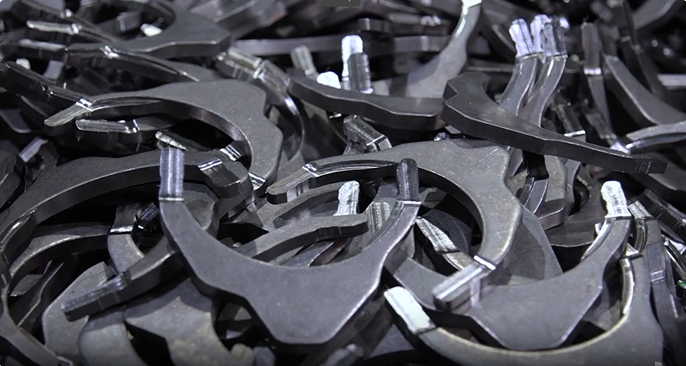
Fineblanking or machining: the choice affects cost per part, industrialization lead times, and repeatability in production. These are the technical criteria for deciding.
Precision machining and fineblanking often compete for the same metal part. The choice affects cost per part, industrialization lead times, and repeatability in production. In the automotive industry, cost pressures and new e-mobility components are forcing manufacturers to reassess legacy production processes. Here are the technical criteria that help guide the decision when reviewing a part drawing.
Two Different Manufacturing Approaches
Fineblanking is a precision stamping process carried out on a triple-action press. A blank holder clamps the sheet metal, a counterpunch supports it, and the punch cuts with minimal clearance. The result is a smooth cut edge across almost the entire material thickness, with no tearing.
In contrast, machining removes material using tools controlled by CNC (Computer Numerical Control) systems. Its main advantage is geometric flexibility. Its limitation is cycle time: each part requires machine time and generates chips.
- Fineblanking: Near-net-shape part produced in a single press stroke using a dedicated die.
- Machining: Finished part produced through material removal, without the need for expensive dedicated tooling.
3 Criteria for Choosing Between Fineblanking and Machining
1. Geometry and Material Thickness
Fineblanking is well suited for flat parts or components with simple formed features such as gear teeth, holes, countersinks, and bends. A progressive die can cut, form, and flatten burrs within the same sequence.
Deep cavities, internal threads, and complex 3D surfaces still typically require machining operations.
2. Production Volume
A die represents an upfront investment that is distributed across all manufactured parts. For high-volume production runs, the unit cost of fineblanking is generally considerably lower than machining.
For prototypes, low-volume production, or designs that are still evolving, machining avoids tying up capital in tooling.
3. Tolerances
Fineblanking can achieve tolerances up to IT7, IT8, or IT9, depending on material thickness.
Machining can achieve these same tolerances, but typically at a significantly higher cost.
When Precision Machining Remains the Best Option
There are situations where precision machining is the most sensible solution:
- Low or uncertain volumes: product launches, spare parts, or validation batches.
- Three-dimensional geometries: deep housings, internal threads, or turned surfaces.
- Frequent design changes: every die modification adds cost and lead time.
- Materials or thicknesses outside the process range: applications exceeding press capabilities.
- Edge quality requirements: applications requiring perfectly straight edges without edge roll-over.
In many components, the best answer is a hybrid approach. Consider a realistic example: a cam used in a locking system is produced by fineblanking, while only a threaded housing feature is machined afterward. In this way, machining is limited only to the features that truly require it.
What Elay Brings by Combining Fineblanking and Machining
Elay has specialized in fineblanking since 1970 and operates more than 17 triple-action presses ranging from 320 to 1,200 tons. This equipment enables the processing of material thicknesses up to 16 mm in carbon steel, stainless steel, aluminum, and copper. Machining is integrated as a complementary operation, together with welding, riveting, and assembly.
Key capabilities include:
- Technology substitution: Through co-design, Elay evaluates opportunities to convert machined, die-cast aluminum, sintered, or laser-cut parts to fineblanking.
- Integrated finishing operations: Double-disc grinding, wet brushing, and deburring within a single production chain.
- Process control: The DOIKA Process standard includes inspection through machine vision and eddy-current testing.
A Decision Best Made at the Design Stage
The choice between fineblanking and precision machining depends on three key variables: geometry, production volume, and tolerance requirements. Making this decision during the design phase helps avoid costly redesigns and late-stage secondary operations.
The most effective approach is to review the part drawing with the manufacturer before finalizing the design.
To evaluate the feasibility of a component, Elay's technical team is available to provide guidance and answer inquiries via its contact page.